Yu Ji’s recent paintings and drawings align him with the evolved art of the spectacular school of highly skilled representational painters like Carl Dobsky and Adam Miller emerging during the first two decades of this century. These muscular artists successfully turned their figurative paintings into effective tools of measured appraisal gauging the contemporary American experience with sharp-eyed observations and subtle wit. Not politically partisan, but certainly oriented to social commentary and critique, these paintings point a piercing eye at the lives they know, at lives lived by the citizens of this glorious land, at lives lived between sea and shining sea.
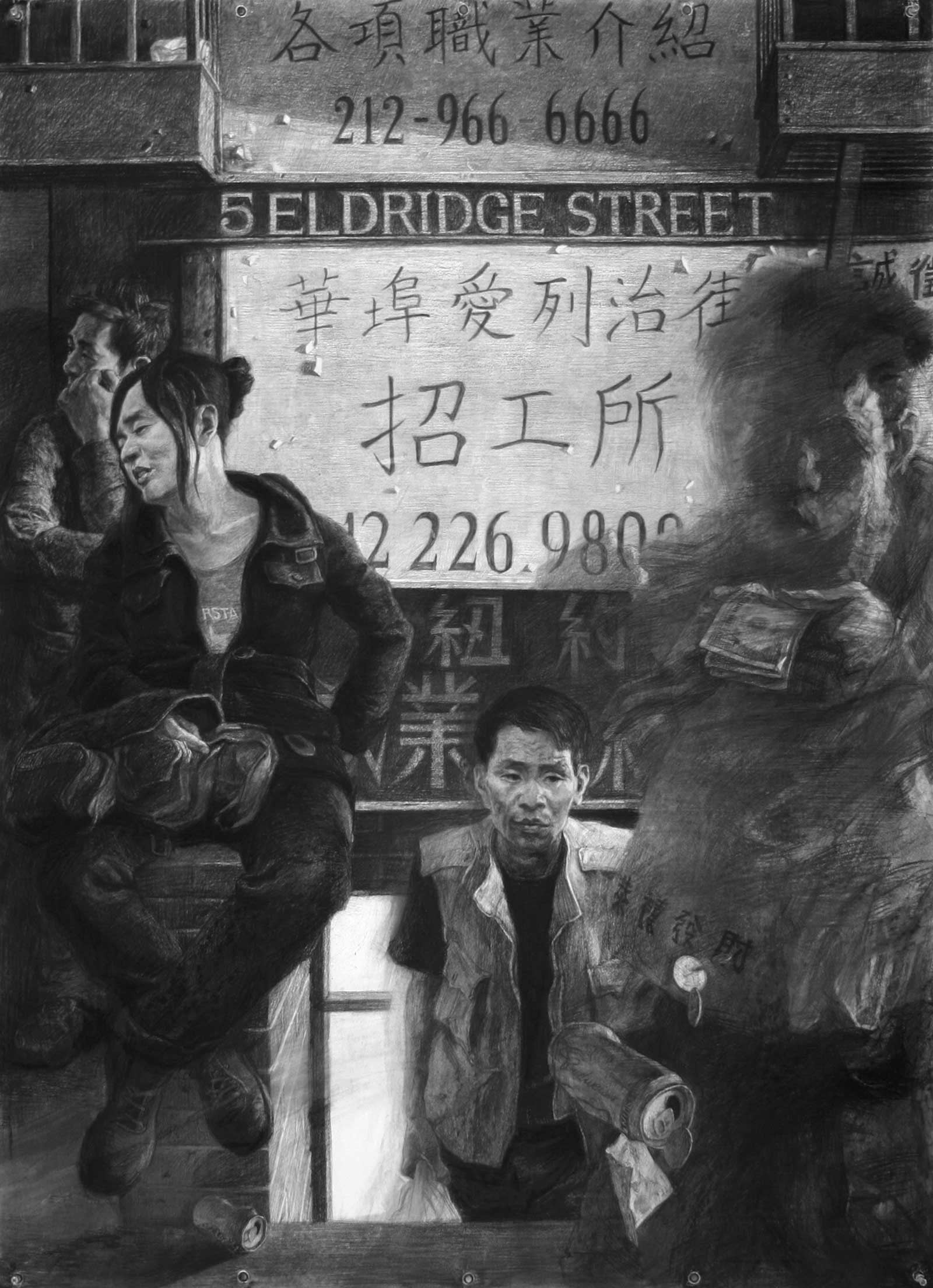 From Eldridge Street, 2010, conte and charcoal on paper, 58 x 42”
 Yu Ji was born into a bourgeois family in Beijing in 1954, predestining him to live through the terrifying decade of the Cultural Revolution which began in 1966. Because both his parents were American-educated doctors, in 1971 he was sent to work for farmers in the countryside—a re-education program designed to teach youths like him the proletarian life. “My family were not considered red enough,” Yu Ji explains. “It was a crazy era.” His sister was sent to the Russian border while Yu Ji worked 15-hour days, close to Beijing, ploughing fields, harvesting corn and feeding pigs.
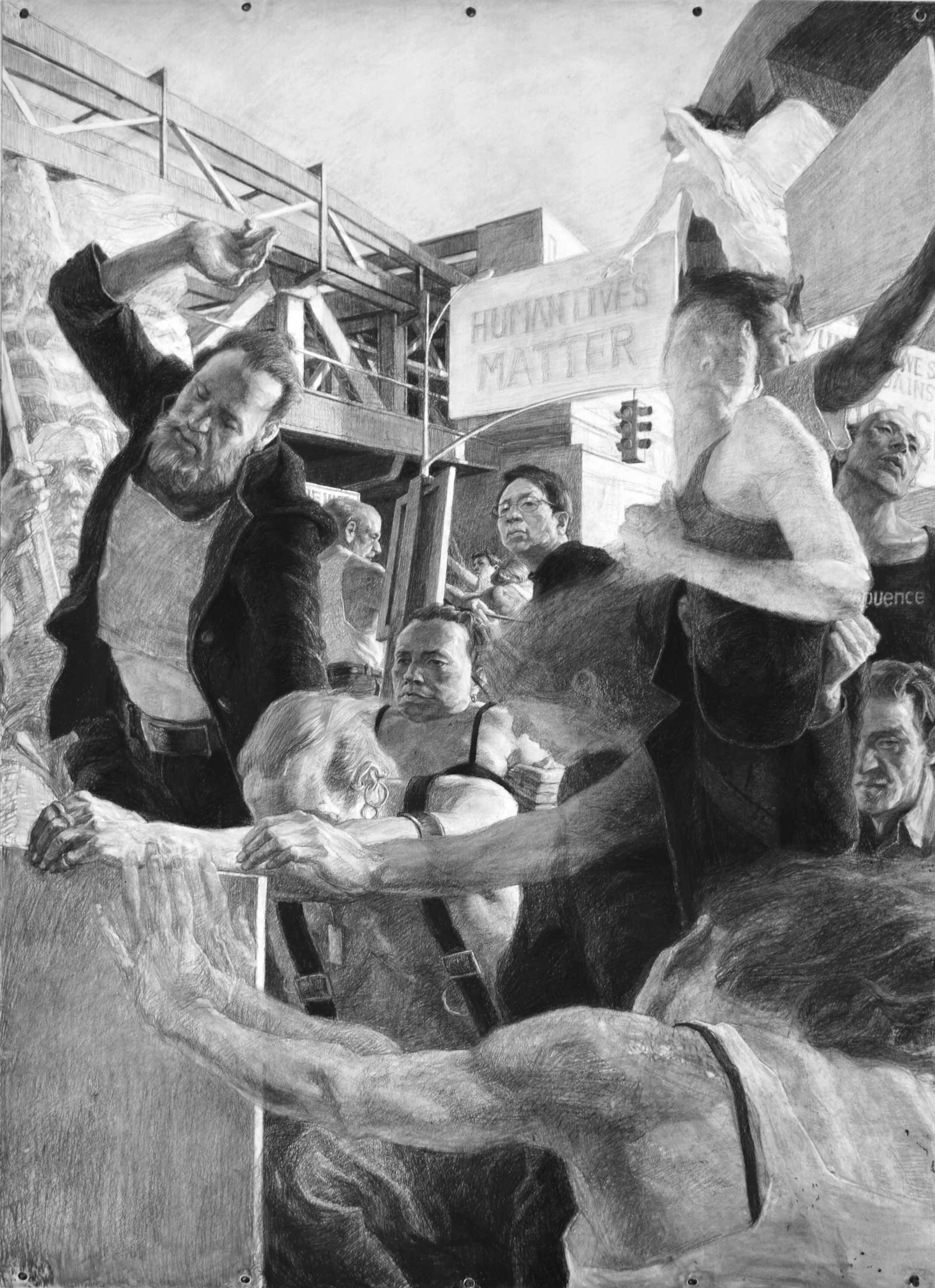
Human Lives Matter, ca. 2016, conte and charcoal on paper, 58 x 42"
Always interested in drawing and painting, which provided welcome relief from labor on the land, after he turned 20, he began learning techniques from the socialist realist propaganda painters Chen Yifei, He Kongde and Wu Biduan, traveling to and from the peasant farmland to meet them secretly in the city. All art schools were shuttered as corrupt bourgeois institutions or beds of Soviet-influenced revisionists then, but in 1977, he was accepted to Beijing’s Central Academy of Fine Arts and proved himself a diligent and talented painter. To Yu Ji’s surprise, when President Deng Xiaoping took power and instituted his new “open door” policy, he was able to leave China for the United States, and enrolled in the masters program at State University of New York at Oneonta, where he met important American representational painters like Jack Beal, whose complex compositions and disregard for the conventions of ordinary spatial relationships would become a powerful influence on his work.
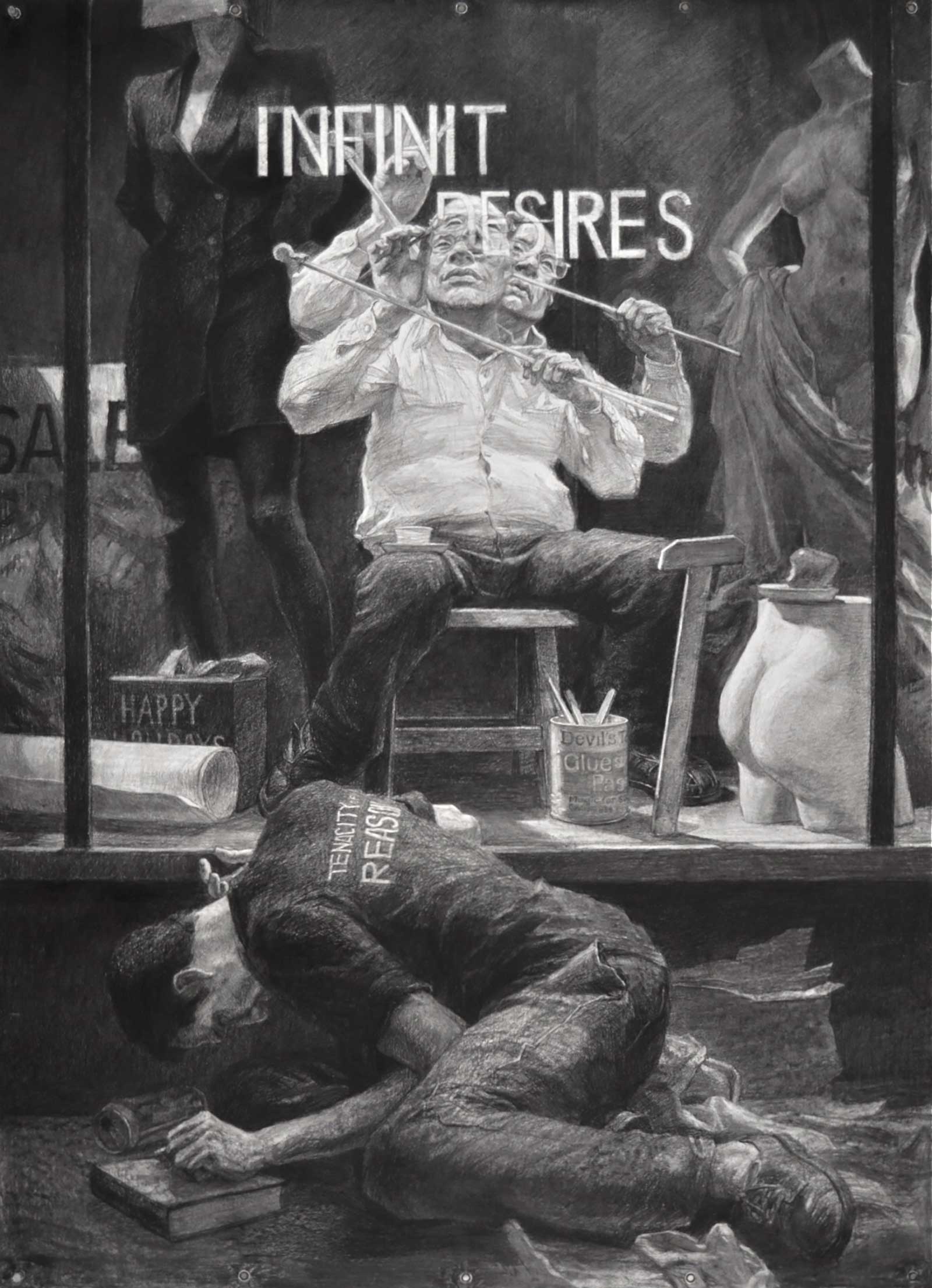
Infinite Desire, 2015, conte and charcoal on paper, 58 x 42"
In New York, an avalanche of urban images tumbled through Yu Ji’s imagination, but at first, the formal structures of his teachers and the schooled propaganda of China’s authoritarian discipline confined him to caution. He developed a method of composing studio paintings from drawings gathered in the wild places of the city like Washington Square, where he spent hours of his free time drawing the people of the richly polyglot and diverse community, filling sketchbooks with figures.
The bright light currently turned upon illegal migration has driven Yu Ji’s paintings into especially sharp relief, as important expressions of the thoughts and sentiments of legitimate immigrants into this extraordinary nation.
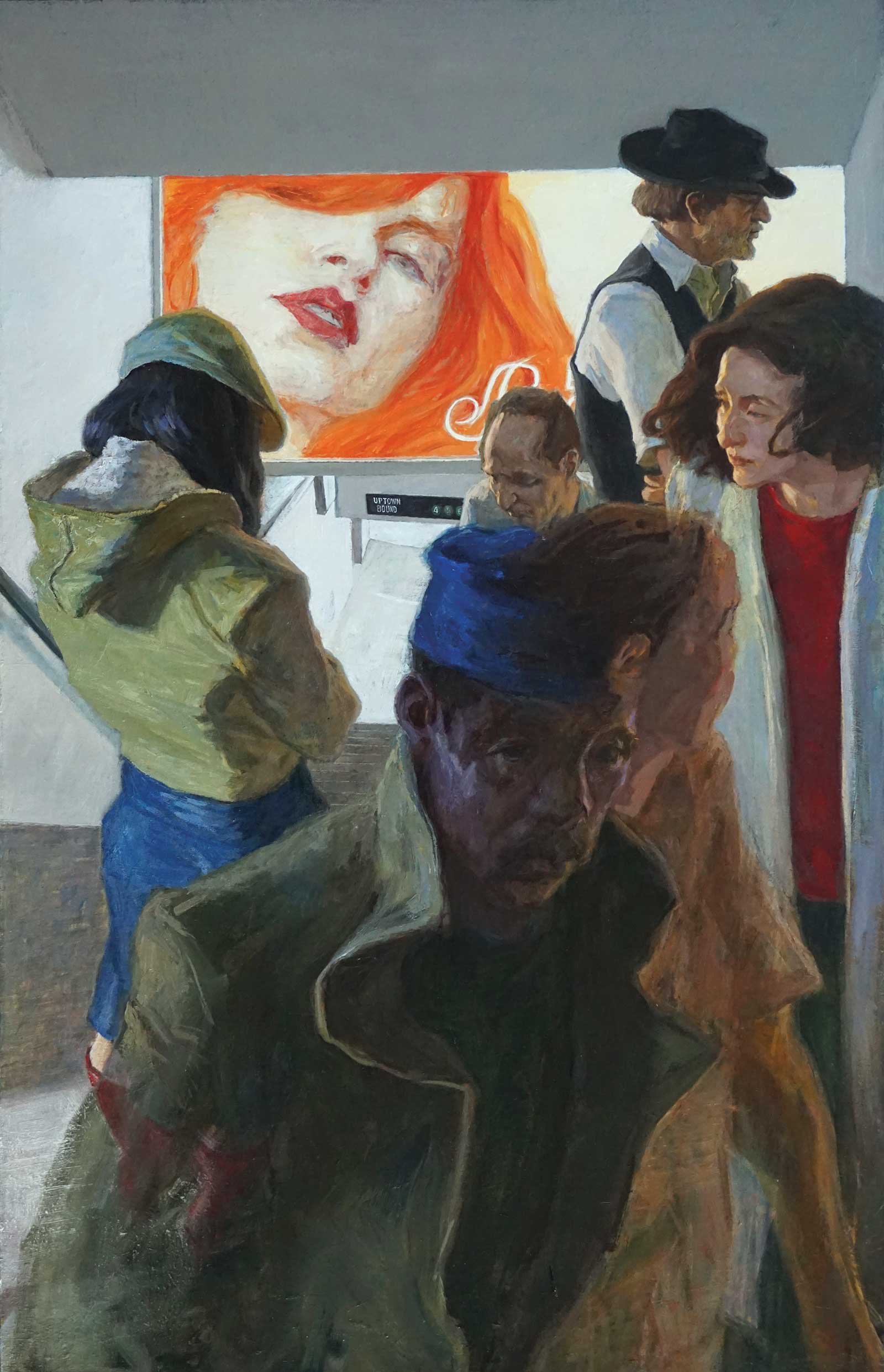
Transit, 2020, oil on canvas, 50 x 32"
Seventeen million people have become citizens since radical Islamists piloted jets into the twin towers of the World Trade Center in 2001. In this new world, Yu Ji has a unique perspective on the experience of arriving in this country.
From Eldridge Street is a conte and charcoal masterpiece set in a shabby New York city street where immigrants gather at the steps of a labor exchange in the basement of a brick and steel-clad building. It is a drawing of Yu Ji’s memory of arriving in the United States when his spirit was lifted from the darkness of oppression into the bright freedom of America. It is an allegory of Yu Ji’s emergence from the underworld of enforced labor he had experienced in China, into the capitalist light of liberty, but finding the light from that opened door shining onto a shabby and broken street, where he was alone, isolated among scattered and floating trash, and a ghostly figure grasping at translucent money. He recalls, “I was pretty shocked when I came to the United States. Materialistically it was so rich, but interpersonal relationships were relatively cold. I did have very good teachers, and I’m very grateful to them.”
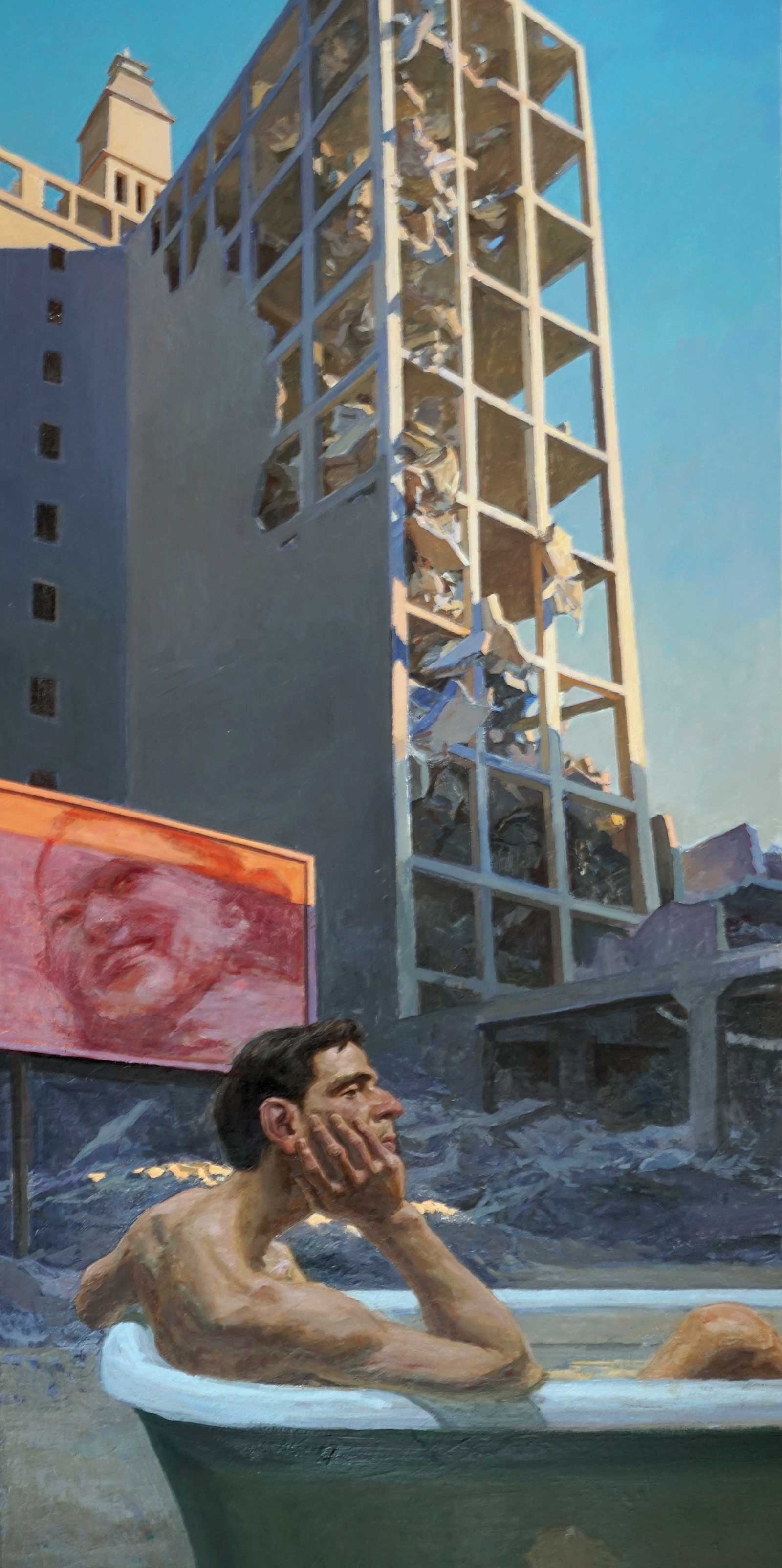
Urban Corner, 2016, oil on canvas, 48 x 24"
This tension between Yu Ji’s clear delight in American opportunity and the caprices of capital are clear in his Infinite Desires, another superb studio drawing rendered in conte and charcoal. He depicts a sign-painter, armed with steady focus like a many limbed bodhisattva flanked by mannequins, one in a chic black dress, the other naked under Aphrodite’s half-shed white robe—exposing herself for the judgment of Paris. “He was painting the signage inside the window,” says Yu Ji, “…[and] I was standing outside drawing him. He didn’t seem to mind. It was really about this luxurious life inside the window, so that’s why I put the other man in front. I attempted to create a reciprocal antagonism between an outside reality and an inside illusion. Reason and rationale were sleeping.” The apple is Eve’s temptation, too, then, offered on a naked and inviting plaster bottom, and the man collapsed outside the guarded gates to paradise is fallen Adam crumpled over his book and labeled with the words “Tenacity of Reason” in the same sans serif font as the limner’s script. Abandon your grip on reason to the commercial temptation of infinite desire.
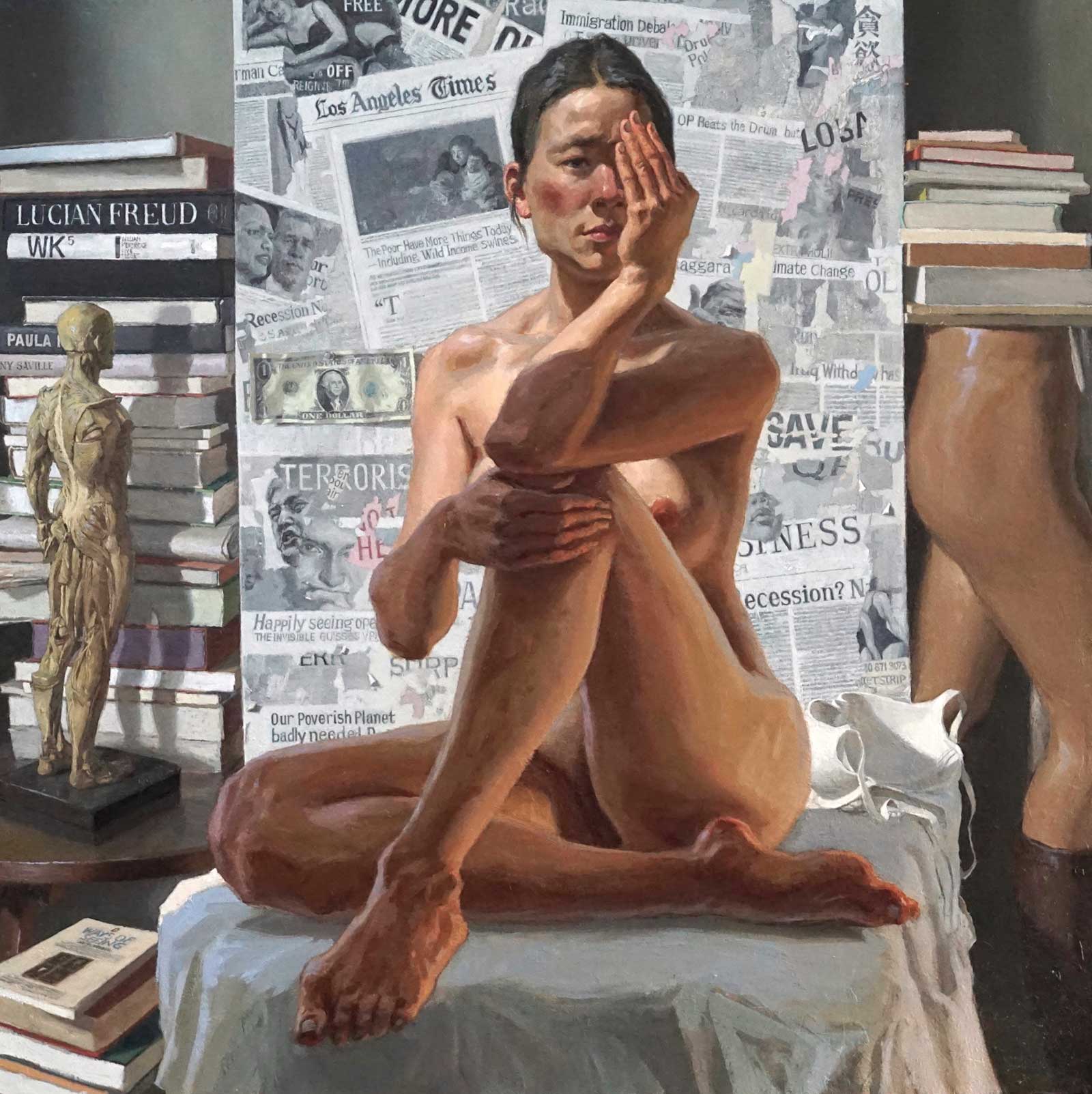
See No Evil, 2019-24, oil on canvas, 36 x 36"
The theme of emerging from the underworld arises again when a brash image of a woman appears frozen on a billboard in Transit, where she is a commercial model cast in the flickering cadmium orange of the flame and furnace, gaping sensually over subway commuters. Among them a blue-capped Chinese Orpheus, emerging from the stoic tunnel out of the underworld, an immigrant Orpheus walking among the sleeping dead who only dream of monied uptown life, focused on the capitalist task of building their estate while Euridice remains doomed in Hades.
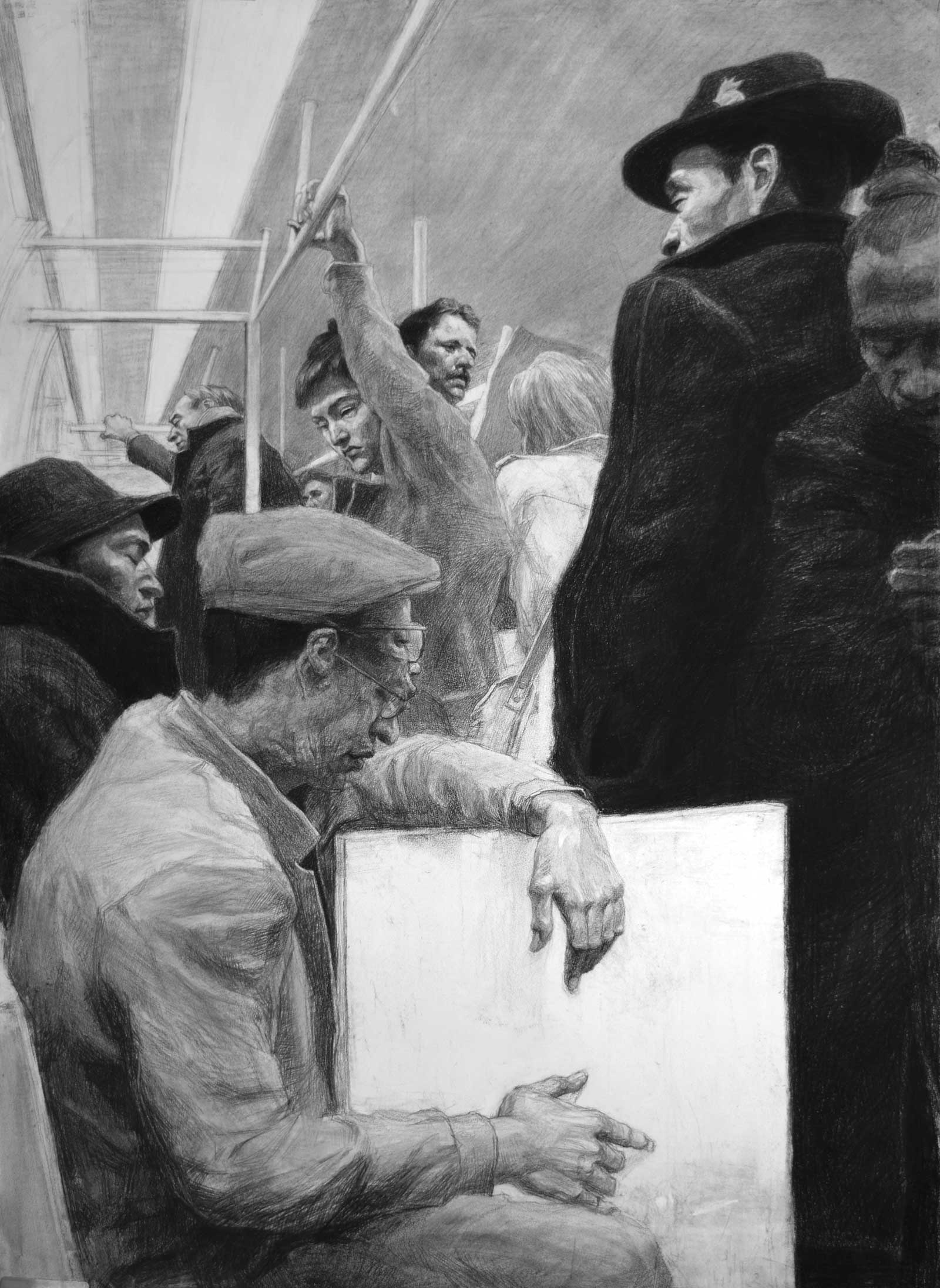
Subway Riders, 2017, conte and charcoal on paper, 41 x 23"
In See No Evil, the model partially covers her face with a cupped hand. Clearly, the title is plucked from the platitude “see no evil, hear no evil, speak no evil,” but in this picture, Yu Ji has cleverly referenced another expression which became a popular Chinese idiom during the 20th century: “keep one eye open and one eye closed,” recommending a state of discretion—being aware of inconvenient truths but choosing to ignore them. This was pragmatic and practical advice during the red season of blood and violence weathered under the cultural revolution, and shaped the character of a generation of China’s children as they fled into the arms of America.
See No Evil must be read and demands interpretation. Behind the woman’s naked body there is a partition plastered with the headlined papers of the popular press, and words pop from the grisaille collage of print. “Terrorist,” “immigration debate,” “climate change,” “recession.” These boldened issues given the monied lie by a crumpled dollar bill of finance, but kept discretely out of sight from an eye darkened by the practical hand of necessity and the quiet life. Stacks of art books flank the model, and give further clues to interpretation, for Yu Ji is a subtle and perceptive allegorist, and often builds quiet chains of metaphors in his pursuit of meaning.
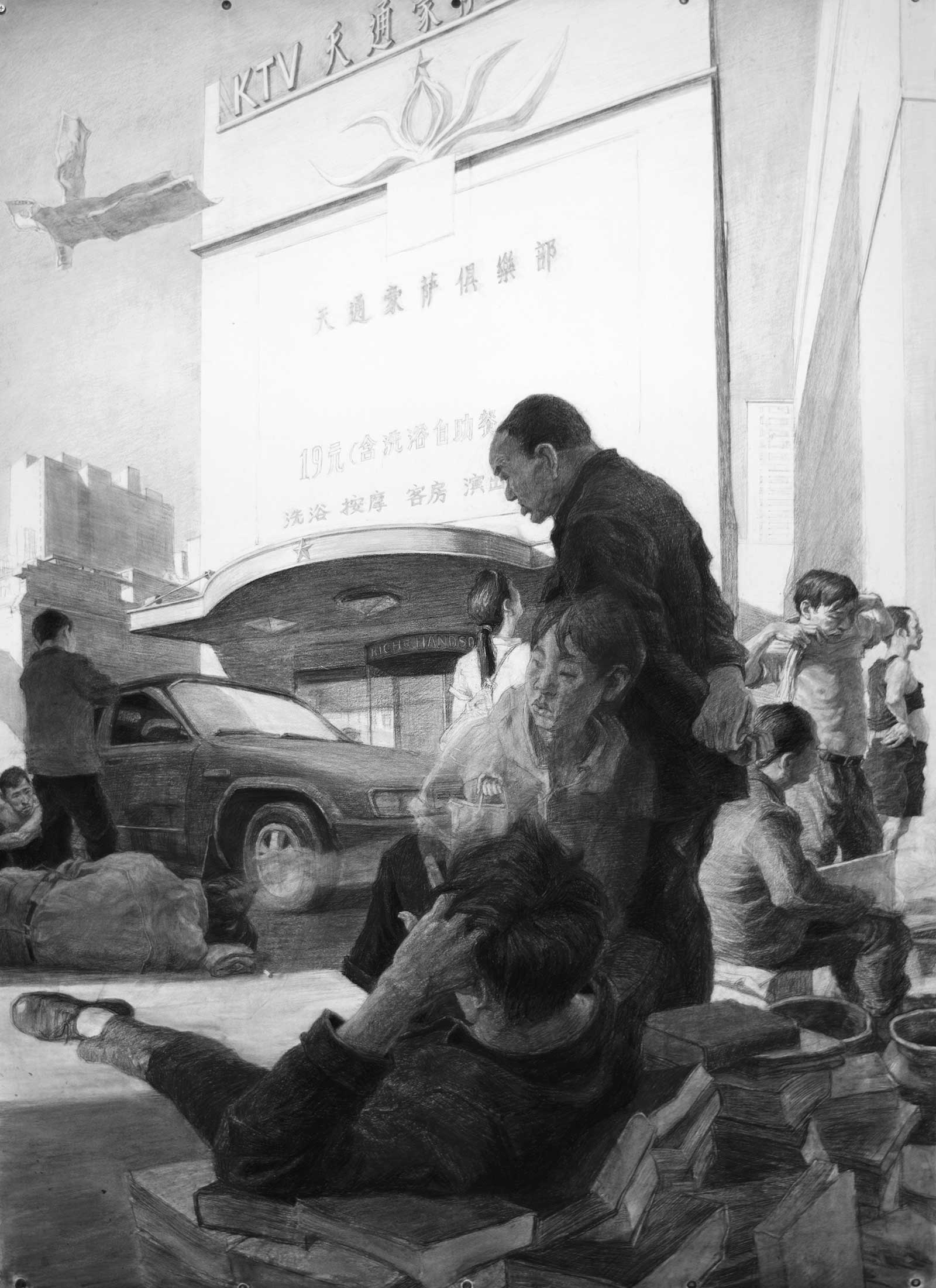
The Tiantong Rich & Handsome Club, 2018, conte and charcoal on paper, 58 x 42"
On the left there are volumes by Lucian Freud and Jenny Saville, both British painters of mountainous bodies of lumpen and enormous flesh. In the 1980s, Freud was famous for his poopy impastos of massively obese male and female models wracked like washed up sea-monsters floationg onto his studio divan. In the 90s, Saville emulated him with her huge paintings of grotesque and flabby women, briefly celebrated during that period when we were meant to pretend that all ugliness was beautiful. The title of another volume is half-obscured, but Yu Ji revealed it as the work of Portuguese artist Paula Rego, who painted women posed as dogs, exposing the violence of men’s treatment of the sex, while simultaneously subverting the critiques and complaints of conventional feminism. Most dominant in the foreground though, and providing the clearest clue that Yu Ji’s work is intended to be interpreted thus, is a copy of John Berger’s famed book Ways of Seeing, which described how images could only be read through the social context of the viewer, whose personal histories and circumstances were deeply in dialogue with their experiences of imagery.
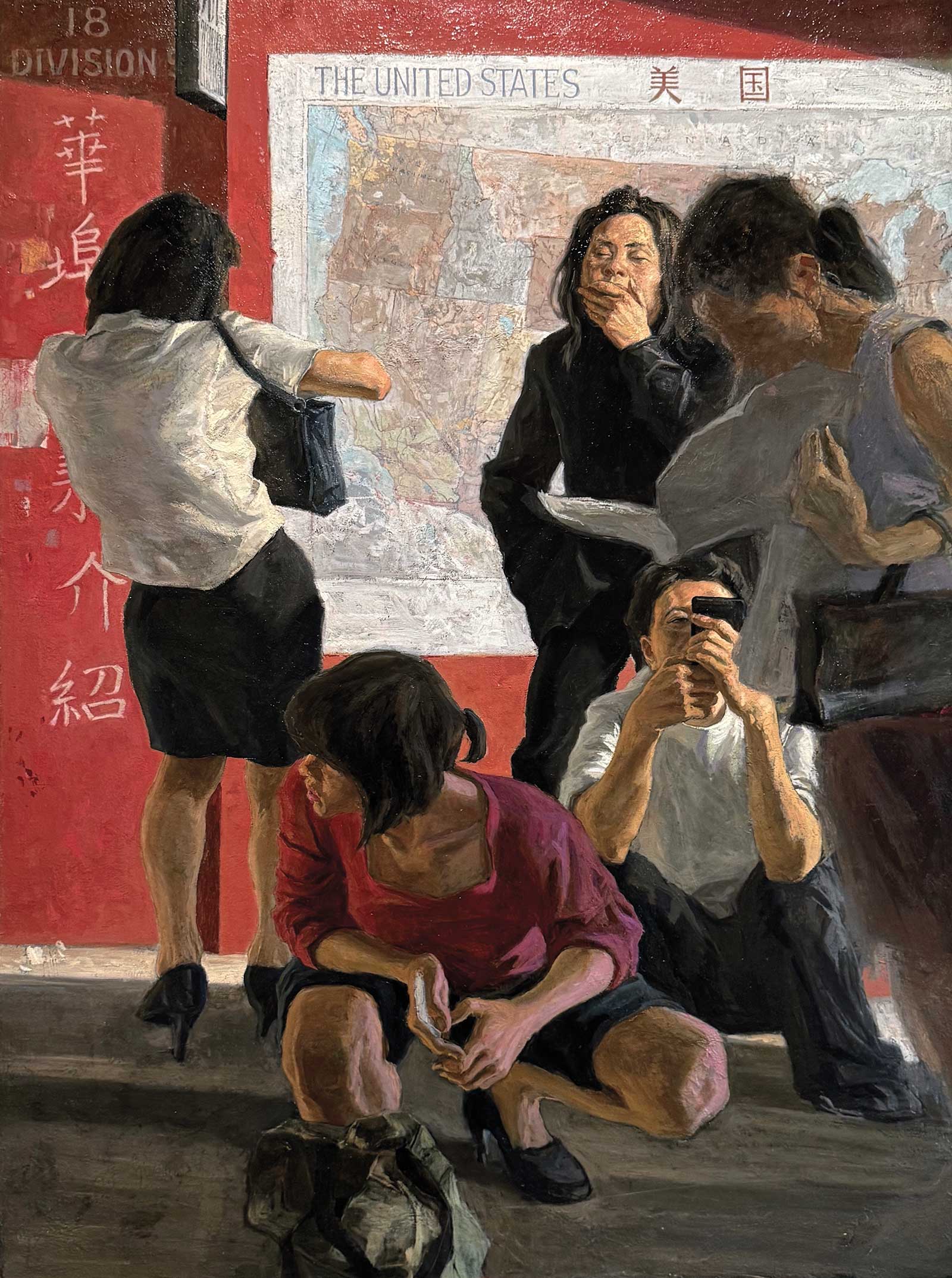
Line Walkers (Job Hunters), 2022, oil on canvas, 48 x 36"
Who will see no evil, then? In See No Evil, Yu Ji’s model, watching us watching her with one eye open and one eye closed, suggests that a beautiful, naked woman depicted in a painting may be self-aware of her role as an object of sensual desire at the same time she is a symbol of social critique and outrage. She is something of an Aphrodite displayed here, as if waiting for judgement, but she already has Paris bribed and primed to award her the golden apple as a corrupted prize for her vanity. Half a mannequin from a commercial display suggests that in the narrative of gendered exploitation, much remains unchanged. Although we have seen behind great Oz’s curtain of manipulation, we choose the one-eyed path of discrete resignation to biological reproduction.
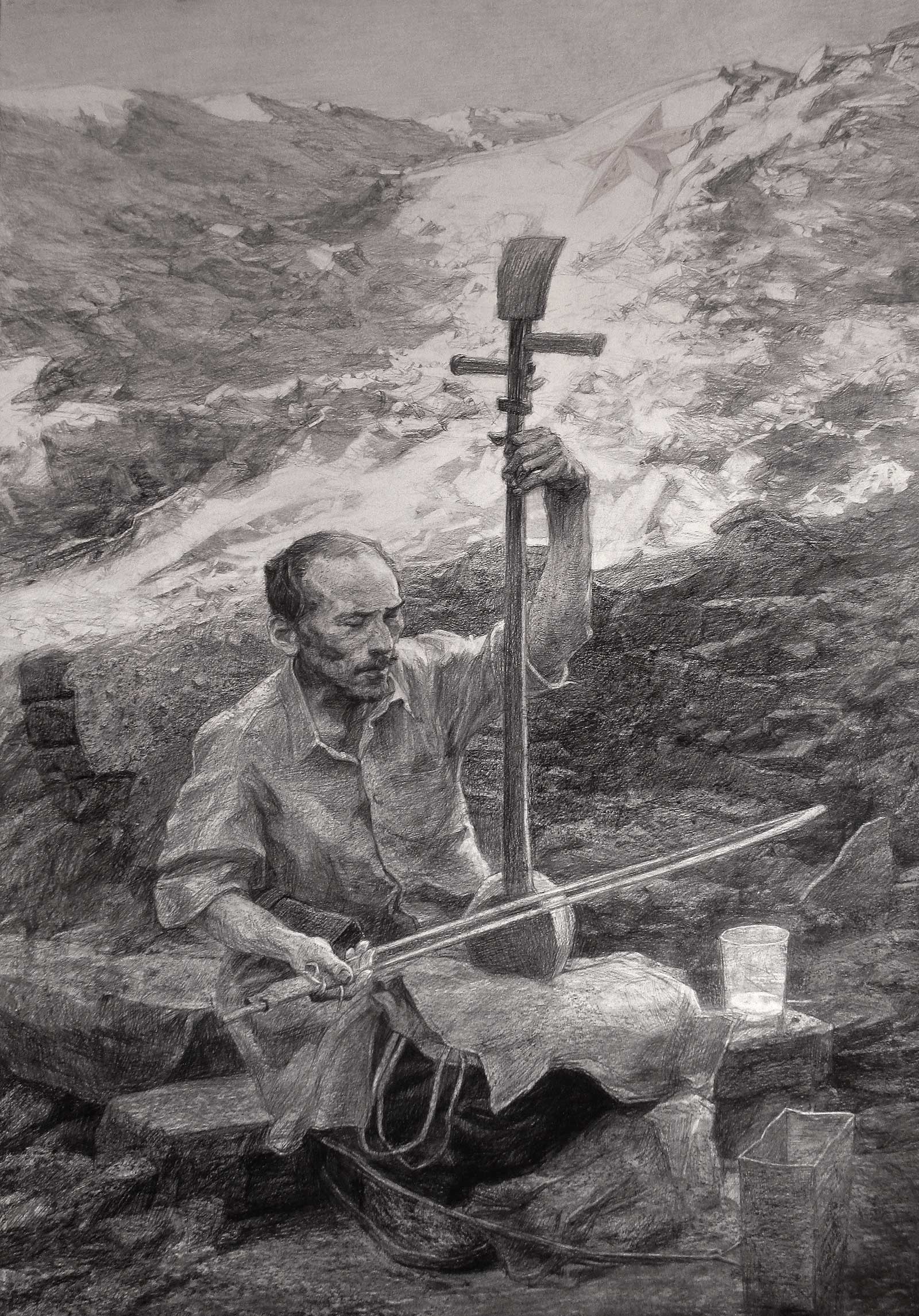
Into Oblivion, ca. 2010, conte and charcoal on paper, 50 x 38"
See No Evil examines the ambiguity of female strength and sexuality, but Urban Corner addresses the problem of male weakness. A half-demolished high rise cuts a cerulean sky and tops the slender frame around a tall composition unmistakably set in the golden light and honied concrete of California. Aphrodite in her marketable archetype returns as the setting sun of the magic hour flares, rubble piled before the broken building and a billboard bearing the commercially pink image of a snickering woman who seems to smirk at a naked man shamed by public display in a bath. Complacent and vacantly unaware of his humiliation, he lounges in his tub. The smashed tower and this eunuched man are gathered as a symbol of emasculated phallic collapse—an allegory of the catastrophic breakdown of modern masculinity and the failure of male strength in the face of shrill protest.
During his tenure in the American academy, Yu Ji took care to resist the orthodoxies of conceptual doctrines and the egalitarian deskilling in vogue during the first decade of this century, depending upon the capacity and endurance he had learned under the clench and fist of the cultural revolution. Ironically, Yu Ji learned his studio technique from masters of socialist realism, from true princes of Maoist propaganda, from teachers as didactic in their ideology as they were pragmatic with their paint, but if a decade of re-education in the fields of the cultural revolution had instilled in him a deep suspicion for authority, it had also birthed a deep and constant curiosity and affection for the lives of ordinary people struggling to find their way in their new world. These are American paintings of strength, paintings of vision, paintings of life in a pioneer nation.
+++
Michael Pearce is a dynamic writer, curator, and critic, and a champion of art that emerges from popular culture and shapes the spirit of the age. He has published hundreds of articles about art and artists, and is author of Kitsch, Propaganda, and the American Avant-Garde.
Powered by Froala Editor